AGL Table Group

Designed by Leon Ransmeier, 2012

Leon Ransmeier’s newly commissioned table group draws insight from the aesthetic and efficient properties of aeronautic design. This influence extends to the name, an aviation acronym for "above ground level." A gracefully tapered edge invites the sitter, while optional power trays mounted at the perimeter reduce clutter and keep creativity flowing during collaborative meetings. Available in an array of sizes and finishes, AGL demonstrates Herman Miller’s commitment to extending the Collection with new designs that are beautiful, enduring, and purposeful. Available in 2013.

AGL Table in Black veneer top, Black base (as shown).

AGL Table in Black veneer top, Chrome base (left).

Eames Executive Chair

Designed by Charles and Ray Eames, 1960

Originally designed for the lobby of the Time & Life Building, this elegant chair exemplifies Charles Eames’s belief that “the details are not details; they make the product.” Generously sized, the deeply cushioned seating features the highest quality materials: an aluminum base and frame, finely detailed upholstery accented with upholstery-covered buttons, and edge details typical of traditional fine furniture. Now available in new finish and material options, it still boasts a tilt-swivel base, adjustable height, and glides or casters to effortlessly merge function and comfort.

Eames Executive Chair shown in Black MCL Leather, Polished Aluminum frame.

Envelope Chair

Designed by Ward Bennett for Geiger, 1966

Like Ward Bennett’s other remarkably timeless designs, the Envelope Chair is subtle and sophisticated. The chair’s confident use of upholstery defines it, as it wraps tightly around a welded tubular steel frame to create a supportive seat, back, and sides. Likewise, this chair wraps around and envelops the sitter. Comfortable and comforting in both formal and informal office and home environments, it’s available in an array of textile and leather selections.

Envelope Chair in Almond MCL Leather, Chrome frame (as shown).

Envelope Chair in Black MCL Leather, Chrome frame (left).

Baguette Table

Designed by Ronan and Erwan Bouroullec for
Magis, 2011

A thin profile supported by slim, chopstick‐looking legs create the illusion of delicacy in this design by Ronan and Erwan Bouroullec. With a name inspired by the original definition of the French word baguette—“wand”—the rectangular table is actually strong, supportive, and confident. The long, thin tabletop, available in two lengths and a variety of options, is removable. The base can be polished aluminum or powder-coated black or white. Versatile and instantly classic, the design makes a statement wherever it goes—from an executive office to a home workspace.

Baguette Table in Extra Clear Glass top and Polished Aluminum base (as shown).

Baguette Table in Black top, Black base (left).

Osso Chair

Designed by Ronan and Erwan Bouroullec for
Mattiazzi, 2011

The idea behind the polished, sculptural Osso Chair was to let the sensuality of the wood material express itself. Compact and minimal, the wood panels of the seat and back are assembled by an advanced digital control system, creating strength to match the chair’s beauty. A natural at home or in an office, it is available in eight stunning colors.

Osso Chair shown in Waxed Ash finish.

Sled Base Storage

Designed by Ward Bennett for Geiger, 1960s

Ward Bennett was not concerned with what was trendy. His focus instead turned to function, comfort, and craftsmanship. As a result, designs like his Sled Base Credenzas remain ready for the work and living spaces of today. Modular in design, these storage solutions vary from single unit pedestals to pieces containing up to four units, with options for finishes, cabinet or drawer configurations, and inserts. Single and double units are available with casters for mobility.

Sled Base Storage in White Ash, Chrome base (as shown).

Sled Base Storage in Walnut, Chrome base (left).

Medici Chair Outdoor

Designed by Konstantin Grcic for Mattiazzi, 2012

With its generous dimensions and straightforward construction, the Medici Chair is a contemporary interpretation of the Adirondack chair. Konstantin Grcic, who trained as a cabinet-maker, used only three-quarter-inch planks throughout—a reminder of the start of production, when a tree is cut into slices. The result is an easy-to-read structure that expresses the characteristics of wood.

Suitable alone or in groups, the Medici uses thermo-oiled ash, a finish that uses a new process of heat-treating and hand-oiling to seal the wood and keep it moisture-resistant. Crafted for strength and semi-reclined for relaxation, the design is sizeable and sculptural.

Medici Chair Outdoor shown in Natural Thermo-oiled frame.

Nelson Swag Leg Desk

Designed by George Nelson, 1958

The concept of George Nelson’s compact desk began when he asked, “Wouldn’t it be beautiful to have a sculptured leg on a piece of furniture?” He wanted this base to be gracefully crafted from metal, machine formed, and easy to assemble. “Swaging,” the use of pressure to taper and bend metal tubes, proved the best method for the legs’ production—and the process lends its name to the distinctive desk. With modest proportions, molded drawers, and hint of color, it makes efficient use of any workspace. Remarkably, more than six decades after its conception its look, scale, and function feel custom-created for the laptops, smartphones, and tablets of today.

Nelson Swag Leg Desk shown in White laminate top, Walnut frame, color dividers, Chrome base.

Nelson Swag Leg Group

Designed by George Nelson, 1958

George Nelson’s Swag Leg Group began from the bottom up, when he asked, “Wouldn’t it be beautiful to have a sculptured leg on a piece of furniture?” He wanted this base to be crafted from metal, machine formed, and prefinished. In addition, he wanted it gracefully curved and easy to assemble.

“Swaging,” the use of pressure to taper and bend metal tubes, proved to be the smartest method for producing the legs—and it is this process that lends its name to Nelson’s distinctive desk, chair, and tables. Remarkably, more than six decades after their conception, the look, scale, and function of the classic pieces feel custom-created for modern living.

Nelson Swag Leg Armchair shown in White, Chrome base.

Eames Storage Unit

Designed by Charles and Ray Eames, 1950

A result of work Charles and Ray Eames exhibited in 1949 at the Detroit Institute of Arts, these units reveal the “machine aesthetic” and Japanese influences important to the couple at the time. With a grid of shelving, drawers, and cases, the pieces are a response to the never-ending need for a place to keep things. The uprights, cross-supports, and perforated panels ensure stability; decorative options, from color-block hardboard panels to molded plywood sliding doors, add playfulness. Available in an array of configurations, the pieces adapt to provide the right level of storage space for casual work settings.

Eames Storage Unit 200 Series 2 Wide shown in Multi-color surface, Black frame.

Nelson Basic Cabinet Series

Designed by George Nelson, 1946

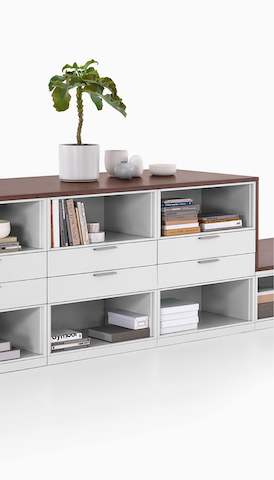
Created to fill the basic need for storage and display with beautiful, simple details, these cabinets and cases are a refinement of George Nelson’s ongoing research into storage furniture that began with his modular “Storagewall” concept featured in Life magazine in 1945. As Herman Miller’s Design Director, Nelson evolved Storagewall into this standardized system of casegoods that can combine and adapt to a variety of uses and environments. Available in several veneer and decorative options, its versatile combination of drawers, shelves, and cabinets may stand alone or be securely stacked atop another landmark design: the Nelson Platform Bench.

Nelson Medium Cabinet shown in Light Brown Walnut veneer.

Nelson X-Leg Table

Designed by George Nelson, 1950

This is the basic expression of what a desk should be: clean and elegant, versatile and resourceful. Designed by George Nelson to function in almost any setting, it balances everything from working to dining to relaxing with equal confidence. It similarly welcomes a variety of chair styles, pairing well with classic Eames offerings and modern designs.

This adaptable piece comes in two laminate surfaces and three veneers, including walnut, white ash, and santos palisander. The rectilinear surface sits atop sturdy legs in trivalent chrome, white, or black, while various sizes set at dining height extend its flexibility even further.

Nelson X-Leg Table shown in Walnut top, Trivalent Chrome base.

Landmark Chair

Designed by Ward Bennett for Geiger, 1964

Stately, softly curved, and confident, the Landmark Chair is Ward Bennett’s most famous piece of work—a representation of his ability to reduce a design to its essence, allowing function, comfort, craftsmanship, and, ultimately, beauty, to be its focus. Carved from solid Ash hardwood, this chair’s classic English form is both light in scale and durable. Several upholstery variations are available for the seating, including a natural caned-back version with loose seat cushion.

Landmark Chair shown in Oban/Mesa by Place Textiles, Ash frame/Burnt Oak finish.

Nelson Thin Edge Group

Designed by George Nelson, 1952

Designed to look exquisite, these cabinets, chests, and cases are an application of George Nelson’s exploration of storage furniture, introduced in 1945 in a feature on his modular “Storagewall” in Life. By 1952, Nelson evolved the concept into “the Rosewood Group.” As the veneer range expanded, it was again renamed in 1958 after the feature that gives it its aesthetic quality: the thin edge framing the doors and drawers.

Fifty years since they were last available, the pieces have been updated with environmentally sustainable veneers and finishing processes, including santos palisander, an option that shares —and honors—the rich personality of rosewood.

Nelson Thin Edge Group shown in Santos Palisander veneer, Polished Aluminum base.

Steelwood

Designed by Ronan and Erwan Bouroullec for Magis, 2009

The Bouroullec’s Steelwood group thoughtfully combines two traditional materials—resulting in simple, straightforward designs that reflect the warmth of wood and the strength of steel. The group is assembled from painted or varnished beech solid wood, painted steel, and high-pressure laminates for tabletops. Together, its subtle silhouettes create easy options that are adaptable to any place needing durable and approachable seating and storage options, work surfaces, or accessories.

Steelwood Chair shown in Natural Beech with White frame.